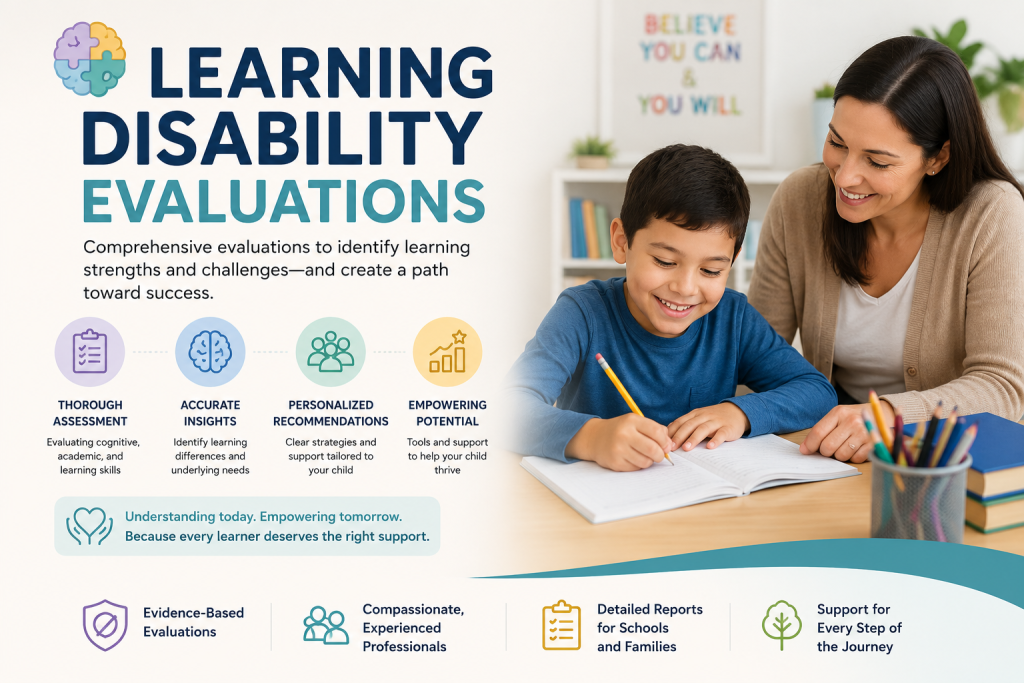
Understand Why Your Child Is Struggling and Discover the Support They Need
Is your child working hard but still struggling with reading, writing, spelling, or math? Are they falling behind despite extra help and support? A comprehensive learning disability evaluation can help identify the underlying reasons for academic difficulties and provide answers, recommendations, and strategies to help your child succeed.
At SoCal Educational Evaluations, we provide comprehensive learning disability evaluations for students in kindergarten through 12th grade throughout California. Our evaluations are designed to identify learning differences, including dyslexia, dysgraphia, dyscalculia, and other processing challenges that may impact academic performance.
Using evidence-based assessment tools, we look at the whole-child by evaluating your child’s cognitive abilities, academic skills, processing abilities, attention, memory, social-emotional functioning, and executive functioning to understand their unique learning profile. Families will receive a detailed report with clear findings, individualized recommendations, and practical strategies to support success at school and at home. Our lead psychologist, Suzanne Swezea, will then provide any guidance that you need for working with your school to get the supports that your child needs based on the evaluation results.
Don’t wait months for answers. Schedule your FREE 20-minute consultation today to learn how a learning disability evaluation can help your child get the support they need.
What Is a Learning Disability?
A learning disability is a neurological difference that affects how a person receives, processes, stores, or communicates information. Students with learning disabilities are often bright, and have average intelligence; however, they may struggle in specific academic areas despite appropriate instruction and effort.
Learning disabilities can impact areas such as:
- Reading fluency and comprehension
- Spelling and written expression
- Math calculation and problem-solving
- Memory and processing speed
- Organization and executive functioning skills
A learning disability evaluation helps identify how your child learns best, what challenges they may be experiencing, why they are experiencing these challenges, and what strategies or accommodations can help them succeed.
What Is Dyslexia?
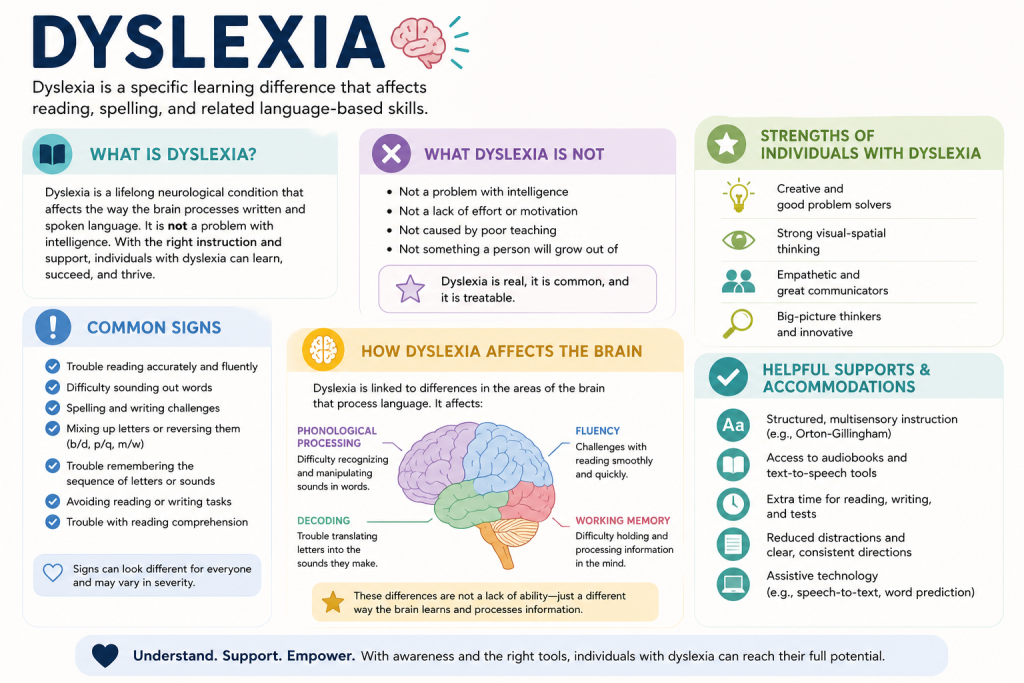
Dyslexia is one of the most common learning disabilities and primarily affects reading and language-based skills. Students with dyslexia may have difficulty developing accurate and fluent reading skills, even when they have received quality instruction.
Common signs of dyslexia may include:
- Difficulty learning letter sounds and connecting sounds to letters
- Slow or inaccurate reading
- Trouble with spelling and written expression
- Avoiding reading activities
- Difficulty remembering sight words
- Reading below expected grade level
- Needing significantly more time to complete reading assignments
A dyslexia evaluation looks beyond reading skills alone and examines the underlying areas that contribute to reading development, including phonological processing, rapid naming, memory, visual processing, and cognitive abilities.
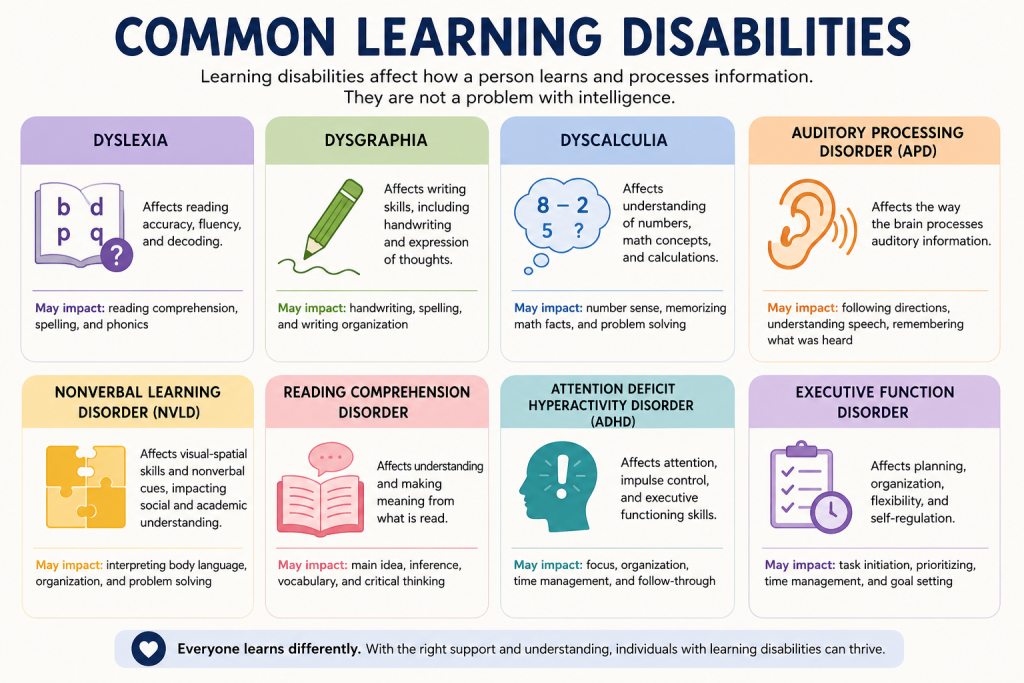
Dysgraphia (Writing Disability)
Dysgraphia affects written expression and handwriting skills. Students with dysgraphia may struggle with:
- Handwriting speed and legibility
- Spelling
- Organizing written thoughts
- Writing assignments despite understanding the material
- Written assignments taking significantly longer than expected
Dyscalculia (Math Disability)
Dyscalculia affects mathematical learning and number sense. Students may experience difficulty with:
- Understanding number concepts
- Learning math facts
- Completing calculations accurately
- Understanding math symbols and procedures
- Solving multi-step math problems
Processing and Executive Functioning Challenges
Some students struggle because of differences in how they process information, maintain attention, organize tasks, or manage their workload. These challenges may impact:
- Following directions
- Completing assignments independently
- Remembering information
- Managing time
- Staying organized
A comprehensive evaluation helps determine whether these challenges are related to a learning disability, ADHD, processing differences, or another underlying factor.
What Does a Learning Disability Evaluation Include?
At SoCal Educational Evaluations, a comprehensive evaluation may include assessment of:
? Cognitive abilities
? Academic achievement skills
? Reading, writing, and math skills
? Phonological processing
? Processing speed and memory
? Attention and executive functioning
? Emotional factors that may impact learning
Following testing, families receive a detailed report including:
? Diagnostic findings
? Explanation of your child’s learning profile
? Recommendations for school support
? Classroom accommodations and strategies
? Intervention recommendations
Frequently Asked Questions About Learning Disability Evaluations
How do I know if my child needs a learning disability evaluation?
A learning disability evaluation may be helpful if your child:
- Is struggling academically despite receiving extra help
- Avoids reading, writing, or math activities
- Takes much longer than peers to complete assignments
- Has difficulty remembering information they previously learned
- Becomes frustrated or anxious about schoolwork
- Has concerns about dyslexia, dysgraphia, or dyscalculia
What is the difference between a school evaluation and a private evaluation?
School districts provide evaluations to determine eligibility for special education services. A private evaluation provides an independent, comprehensive assessment of your child’s cognitive strengths and challenges and can offer additional information to support educational planning beyond what a public school evaluation may provide.
Many families choose private evaluations when they want a more personalized evaluation, faster answers, or additional recommendations beyond what may be provided through a school assessment.
Get Started on Evaluating your Child for a Possible Learning Disability
Can a learning disability evaluation help my child get an IEP or 504 Plan?
A private evaluation can provide valuable information about your child’s learning needs and recommended accommodations. Families can use evaluation results as part of the school team’s decision-making process regarding eligibility and supports. Typically, a private evaluation can help your child with obtaining a 504 Plan, which can provide accommodations, such as Testing and Homework accommodations within their public school or private school setting.
IEPs typically require a public school evaluation; however, if your district has been resistant to evaluating your child, a private evaluation can help get the ball rolling and support your claim for an IEP evaluation through the public school system.
How long does a learning disability evaluation take?
At SoCal Educational Evaluations, comprehensive evaluations are typically completed within one to two weeks, depending on scheduling for your child’s testing session and completion of required questionnaires.
What age can a child be evaluated for a learning disability?
Students can be evaluated as early as kindergarten. Early identification can help children receive appropriate support before academic struggles impact confidence and motivation. Early intervention also can help them keep pace with their grade level curriculum, despite their learning difference.
Help Your Child Get the Answers They Deserve
If your child is struggling with reading, writing, math, or school performance, a comprehensive learning disability evaluation can provide clarity and direction.
Schedule your FREE 20-minute consultation with SoCal Educational Evaluations today to discuss your concerns and learn how we can help identify your child’s unique learning needs.